So we wrote them down instead - and then spent a week trying to prove it does not work.
131complete role documents, across 11 departments
648blind judgings in the last study alone
8 / 8AI judge archetypes preferred our current edition to a plain AI
€100kfor a d-Employee built into your business - €95 if you just want the document
Huceptron · AI & Transformation · Ireland. Press ▶ Present and this runs itself, or use the arrows.
The gap is not effort. It is judgement.
Your people are not slow. They are covering three roles each, and the third one is the one that gets thin.
What actually goes wrong
Not the work nobody did. The work somebody did
at 70% - the compliance note nobody reconciled, the figure nobody traced, the status line that said
“done” when it meant “built”.
Why hiring does not fix it
A senior hire is nine months to productive, €90k+ loaded,
and still only one person in one room at a time. For work that arrives in bursts, that is the wrong shape.
Why a chatbot does not fix it
It is fluent and confident and has no standard to work
to. It will not escalate, will not say what it did not check, and folds the moment a client pushes back.
A d-Employee is the third option: the judgement of a senior professional, written down completely
enough that any AI can perform it - to the same standard, every time.
This is a capacity problem disguised as a quality problem. The output that damages a firm is rarely the work that was skipped; it is the work that looked finished.
What you are actually buying
Not a prompt. A role, written down completely enough that an AI can hold it.
Nine thousand words per role. The system prompt is one section of it. The rest is what turns a capable model into somebody you would let near a client: the standards it works to, the point at which it stops and asks, and the discipline of saying what it verified rather than what it assumed.
Why a prompt is not this
Everyone has tried “act as a compliance officer”. Here is what is missing.
The difference is not length for its own sake. It is that every behaviour a senior person has - escalating, citing, refusing, flagging what they did not check - has to be written down, or it does not happen.
A whole workforce, or one role on Tuesday
131 d-Employees across 11 departments. Buy one, buy a department, buy all of it.
Every one is the same shape and the same standard. They are written to work together - a d-Employee that needs a legal opinion knows which of its colleagues to name.
THE FULL d-EMPLOYEE
The tier the whole thing is built for
A d-Employee that is actually running in your business - not a document in a folder.
The €95 document is the entry point and we describe it modestly on purpose: it is good starting material for a capable team. This tier is different in kind. It is the role rebuilt on your work, wired into how that work moves, improved on measured evidence in successive editions, and owned by a named human on both sides.
Then we tried to break it
Six controlled studies. Blind judging. Every result published, whether it suited us or not.
Every edition we sell has cleared this gate, and two candidate editions did not clear it and were never sold - including the first attempt at the edition we now run internally. Over fourteen hundred individual judgings across the six studies. That is the only reason the numbers on the next slides are worth anything to you.
The first result
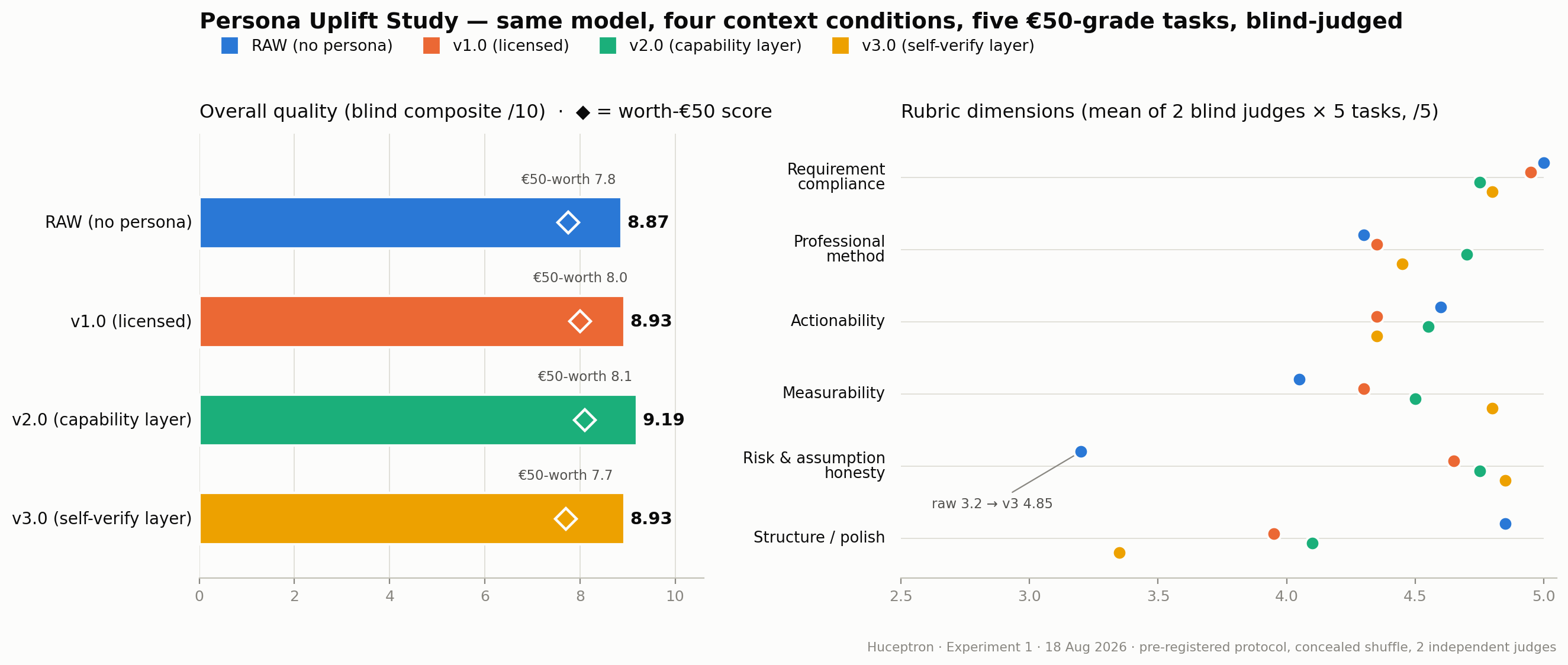
A persona beat the same model with no persona - and every edition after that beat the one before it.
Experiment 1. Four arms, blind, judged by A.I. archetypes who had no hand in writing any of them. This is the study that told us the idea was worth pursuing at all.
Every edition, side by side
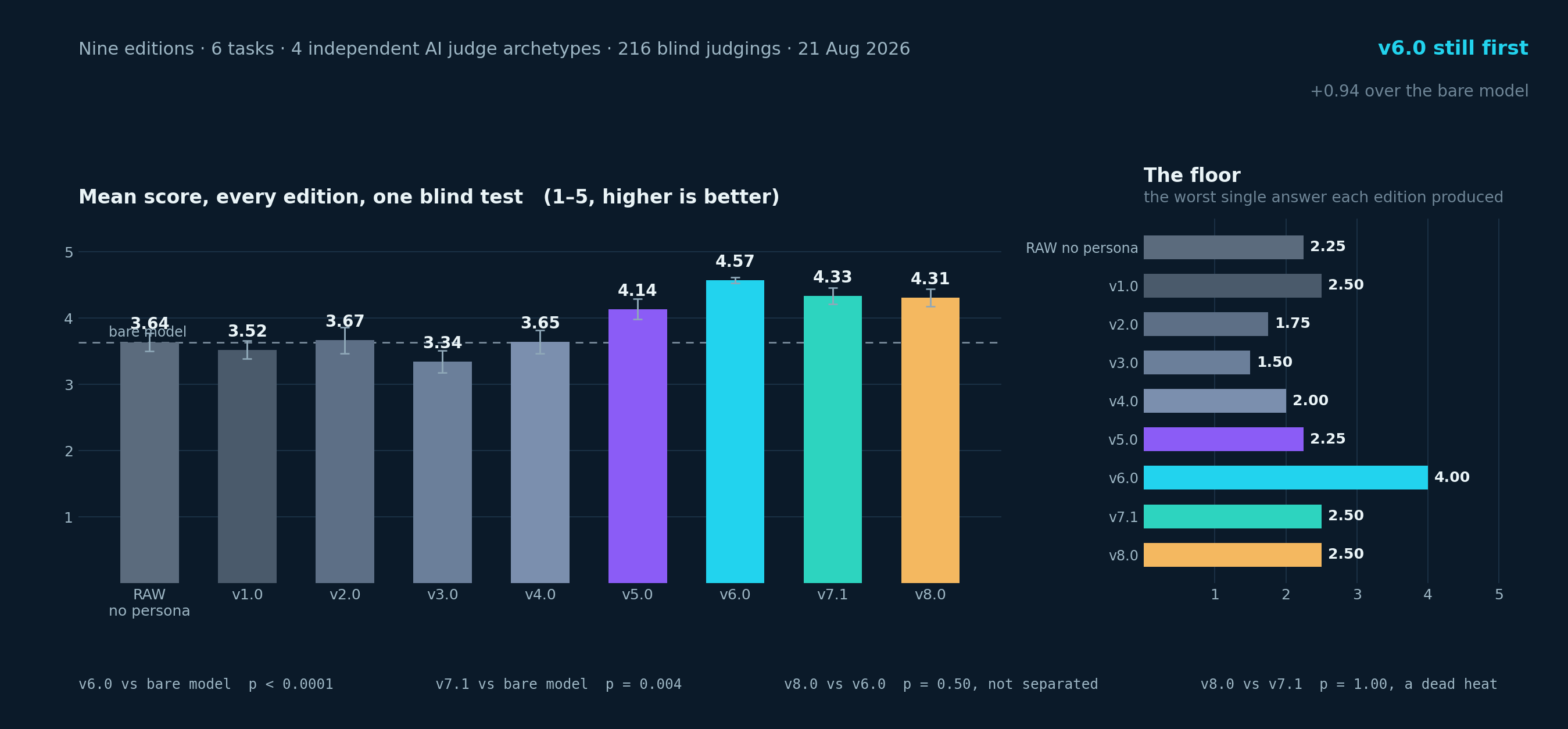
Every edition we have ever built, plus the model with no persona at all - one test, one day, one set of judges.
Experiment 6, 21 August 2026. Nine arms, six tasks, four independent judge archetypes, 216 blind judgings. Note the two early editions that score below the bare model - we publish those too. And note the right-hand panel: v6.0 is the only edition that never once produced a bad answer.
Who each edition is for
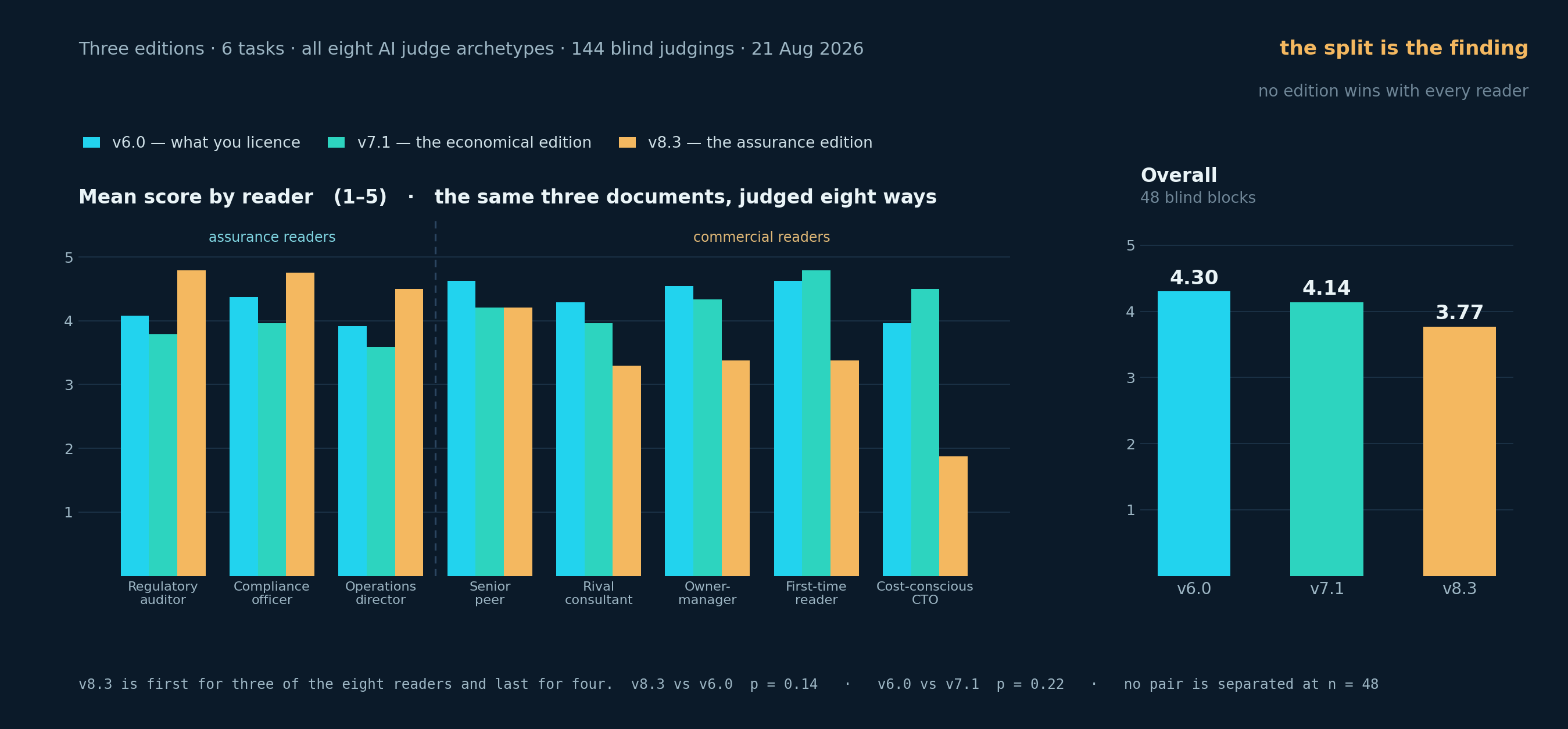
The same three documents, judged by eight different readers. They do not agree, and the disagreement is the product decision.
Experiment 6, round 3 - 144 blind judgings, our largest test. The edition built for maximum traceability is first for the auditor, the compliance officer and the operations director, and last for the buyer counting the cost of the reading. No edition wins with every reader. We would rather tell you which reader you are than sell you an average.
The gap opens where the money is
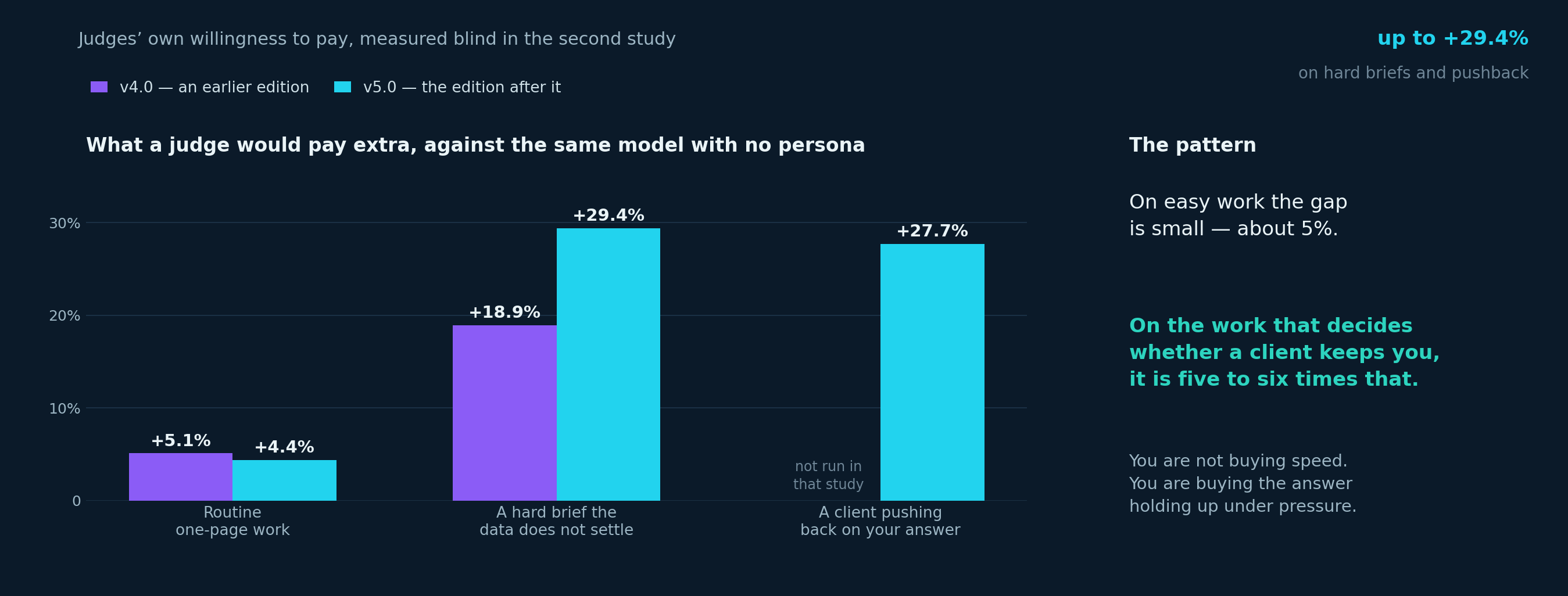
On easy work, a persona is worth about 5%. On the work that decides whether a client keeps you, it is five times that.
This is the single most commercially important chart in the deck. If your work is routine, be honest with yourself about what you are buying. If it is contested, this is where the number is.
Every correction we have made, on the record
Three claims of ours did not survive re-testing. They are on our own wiki, under our own names, with the date.
The claim we published
What happened
“v3.0 beat every later edition on the AI Act task, unanimously”
Did not reproduce. On a fresh regulatory task the current edition placed first on both.
“The plainest answer wins on regulatory questions”
Withdrawn. Same reason.
“The new edition produces 41% fewer words”
Task-specific. Across both task families the two editions are the same length.
Why you are being shown this. A supplier who has never published a result that went against them has either never tested anything, or is not telling you about it. Ask ours to be produced in a dispute and it will hold.
We record our own operational faults on the day they happen too - an address advertised on our site that reached nobody, a checkout that could take a payment and record nothing. Both found, both fixed, both written up.
The fair test
Rebuilt so that neither the old tasks nor the new ones could decide the answer.
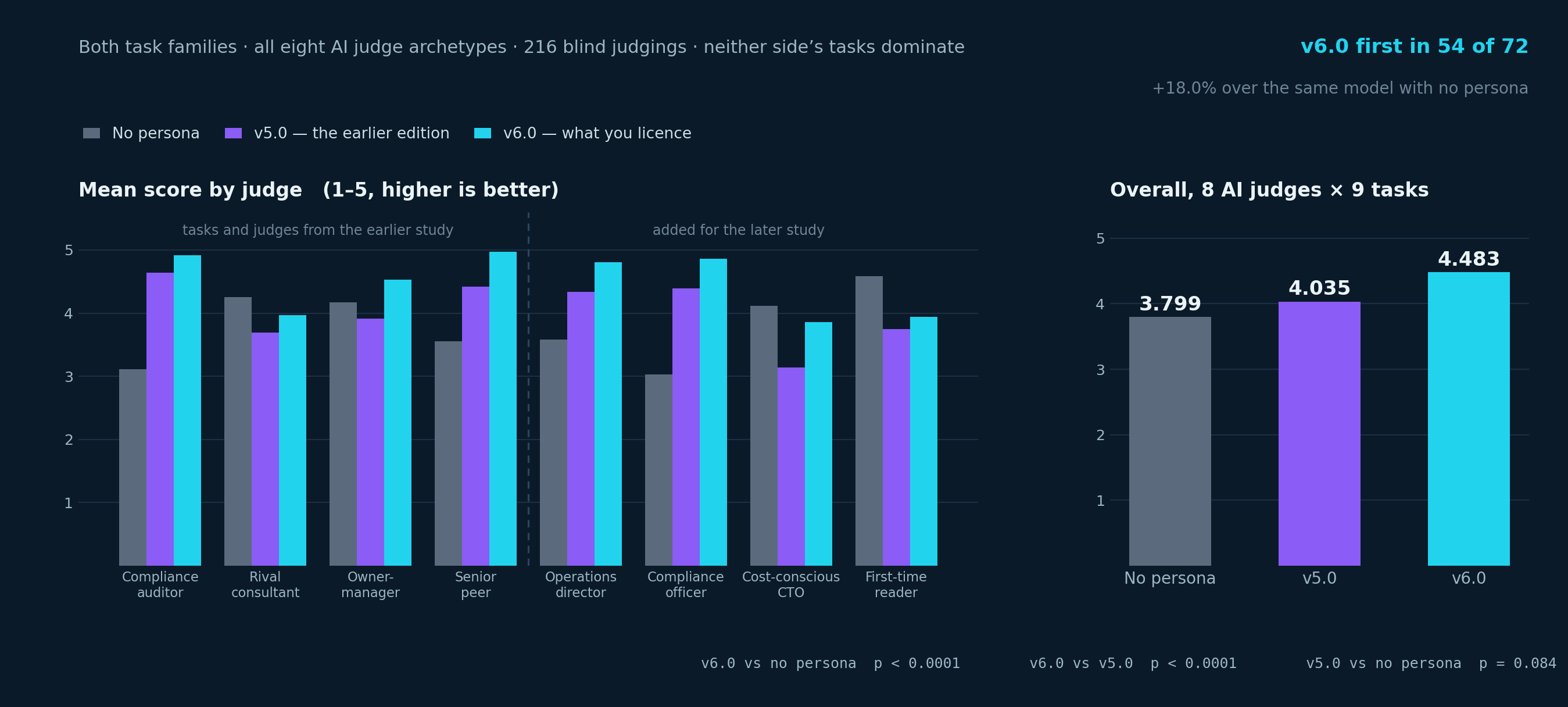
Nine tasks, eight AI judge archetypes (not people), 216 blind judgings, arms shuffled and stripped first. The honest caveat: against no persona the winning arm is also 25% longer - against v5.0 the lengths match, which makes edition-against-edition the cleaner number.
What the fair test cost us
It also killed a claim we would rather have kept.
On this evidence, the previous edition is not measurably better than no persona at all
- plus 0.236 at p = 0.084. That does not clear the bar, so we do not claim it.
It wins clearly with every judge who reads for substance - the auditor, the compliance officer, the senior peer.
It loses with the two who read for cost and first impression. Averaged, that is a wash.
That finding is exactly why the edition you licence today is v6.0 and not the one before it.
Judge
v5.0
No persona
Regulatory auditor
4.64
3.11
Compliance officer
4.39
3.03
Senior peer
4.42
3.56
Cost-conscious CTO
3.14
4.11
First-time reader
3.75
4.58
Mean judge score out of 5, Experiment 4.
We could have shown you only the four judges who like us. The whole reason the number is credible is that we did not.
Then we built the edition after that
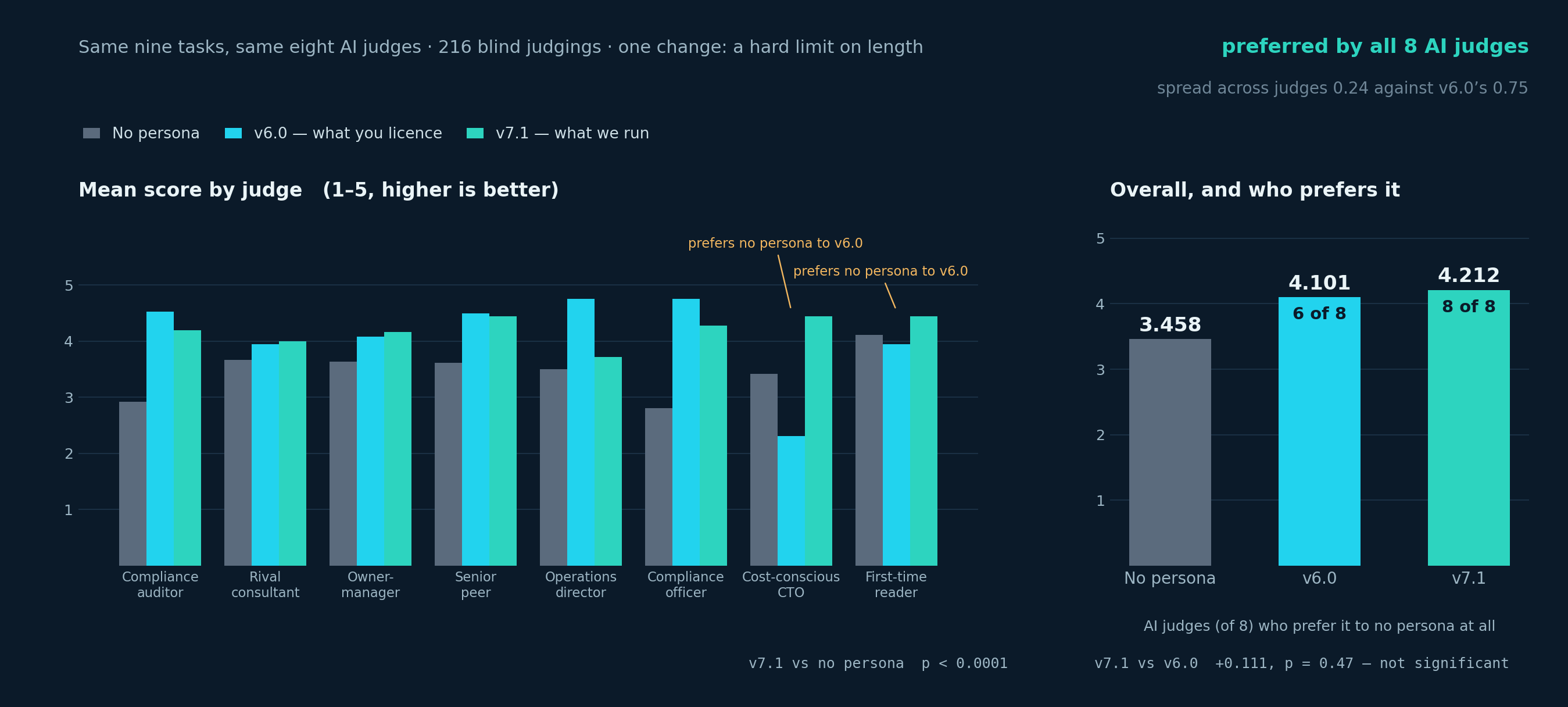
Three attempts. One cleared the gate. You are being shown the two that did not.
The winning change was not more rules. It was fewer - 137 cut to 54 - and a hard ceiling on length. Output more than halved. We do not claim v7.1 beats v6.0 on the average: +0.111 at p = 0.47 is not a result. What is measured is that it is the first edition every reader type preferred to a plain model.
It works the same day
No integration project. No vendor lock-in. No data leaving your stack.
It is plain text. It runs on whatever AI you already pay for. If you cancel us tomorrow, the documents are still yours and still work.
What it is actually built to catch
The failure that costs you a client is the one that fails quietly.
This is a real trace from our own work. Every hop except one fails loudly - you notice no emails going out, a client tells you the link is broken. Hop 2 fails in silence: the client thinks they signed up, and you never learn they exist.
Deployable in a regulated business
Because the line where a human decides is written into every role, not bolted on afterwards.
Written as a standing rule in all 131: anything irreversible is proposed, never executed. That includes anything touching money, identity, publication or deletion.
Your licence is protected
Every copy we issue carries a signature that survives copying, reformatting and pasting into a chat window.
Encryption cannot help here - the AI has to read the text in the clear. So we do traitor tracing instead, and we measured it: 0.978 for the correct licence against 0.511 for the nearest wrong one, with a false-positive probability of about four in a trillion.
What it has to be worth
Only the part we actually add. The rest belongs to the AI you already pay for.
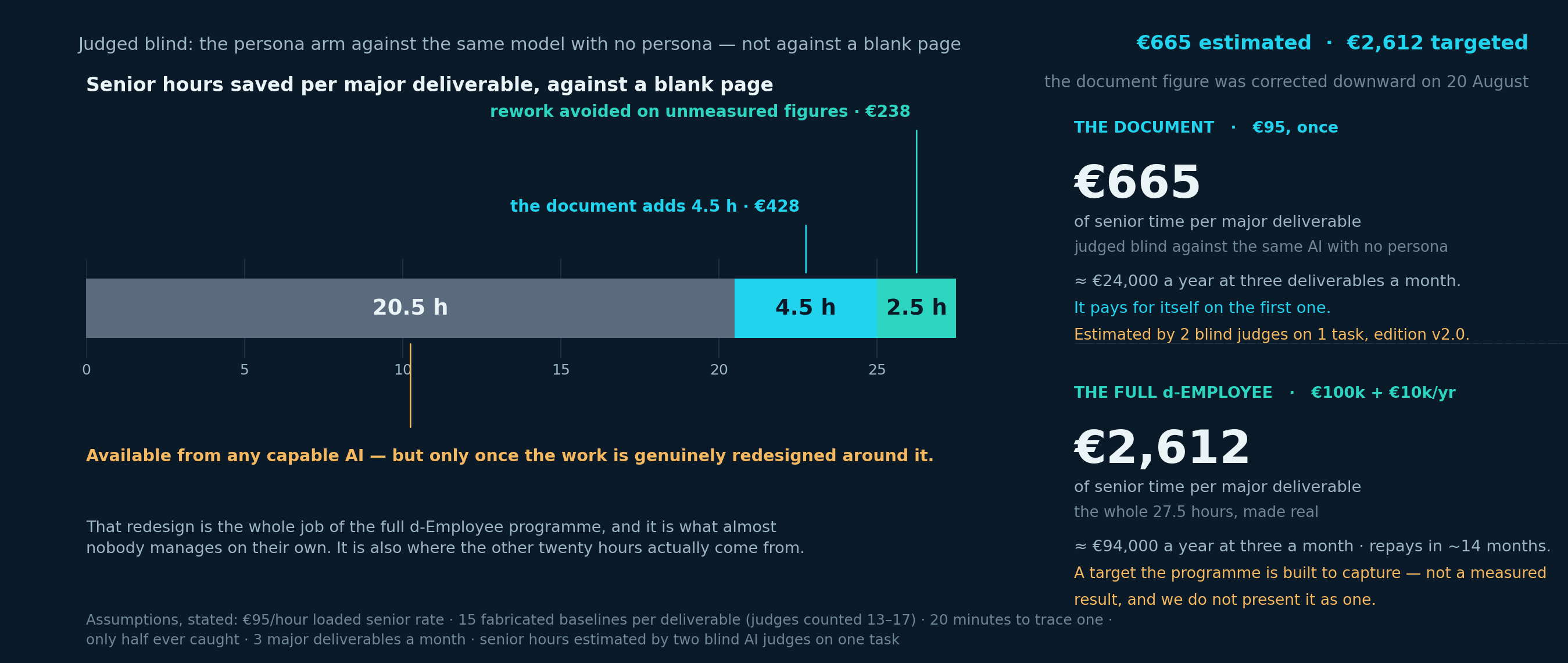
We had this wrong until 20 August and we are not quietly fixing it. The earlier version claimed €2,612 for the document. That was the persona arm judged against a blank page - but a plain model already saves 20.5 of those hours. Estimated on v2.0, four editions ago.
Against what you would otherwise do
Three honest comparisons, including the one where you should not buy from us.
Cost to get going
Time to useful
What you are left with
Hire a senior
€90k+ loaded, per year
6-9 months
One person, one room, one calendar
Retain an agency
€3-8k/month
2-6 weeks
Their method, their staff turnover, their invoice
Write the prompts yourself
Your best person's month
Weeks, then drift
Something nobody maintains after they leave
A d-Employee
€95 - €100,000 + 10%/yr
Same day, or weeks 2-10
A document you own at €95 - or, at €100k, one rebuilt on your work and improved edition after edition
The honest version: if your work is genuinely routine, the measured gain is about 5% and you should
spend the €95, not the €100,000.
We would rather you bought the €95 document and came back in a year than bought the programme and regretted it in a quarter.
Where we tell you not to buy
Published conditions, so you can hold us to them.
If you will not change how the work is done, do not buy the programme. On the document's own measured
value alone - €665 a deliverable - €100k does not repay inside two years at any volume we modelled. The tier only
works if the process changes with it, and that is on both of us.
If the bottleneck is data you do not have, a persona will tell you that clearly and then you still will
not have the data. Fix the measurement first.
If nobody senior will review the output, do not deploy this. Every one of these roles is written to
escalate, and escalation needs somebody to escalate to.
If you need a guarantee of factual accuracy, no AI product can give you one, and any supplier who says
otherwise is selling you something we would not.
We publish the conditions under which our own product is the wrong purchase. That is the same
discipline you are buying.
This slide is in the deck on purpose. The behaviour we are selling - say what you did not check, name the case against yourself - has to be visible in how we sell it, or it is just a marketing claim.
The risk is on us, deliberately
Four ways we take the downside off your side of the table.
The consultation is refundable
€400 for a one-hour consultation, 100% back if you do not
find it useful. You decide, not us.
The audit is credited
The €3,500 readiness assessment is credited in full against
a transformation programme with us.
The workforce is credited too
€2,450 for all 131 comes off the programme fee on the
same terms. Buying the documents first costs you nothing later.
You keep what you bought
The documents are yours. No subscription, no seat count, no
platform to be locked out of. Cancel us and they still work.
Every one of these is on the pricing page, not just in this deck.
THE FIRST STEP WE RECOMMEND
The week that starts almost everything
Five days that pay for themselves whether or not you ever buy AI from us.
This is the most useful €3,500 we sell, and the one we would push you toward first. It is a full transformation readiness assessment as well as an AI audit - a great deal of what comes out of it is ordinary operational and structural work that has nothing to do with AI, and we will tell you so plainly rather than steer you toward a purchase.
WHERE TO START
Three ways in, and one we recommend
The document is cheap and modest. The week is where most of the value is found. The programme is where it is delivered.
€95 / persona
The document
One complete role, edition v6.0, yours to keep
Five for €390 · a department for €690 · all 131 for €2,450
Saved about €665 of senior time on a major deliverable - judged blind against the same AI without it
Good starting material for a capable team - no more than that
huceptron.com/p7p-shop.html
€3,500 / 5 days
The week that starts it - recommended
Full transformation readiness assessment and AI audit
Your processes and over thirty other dimensions examined with your people
A costed 3 to 36 months plan you could execute with a good team of experts
Credited in full against a transformation programme with us
Or start smaller: €400 for a one-hour consultation, 100% refunded if not useful
Start here. Most of what it finds is not AI.
€100k + €10k/yr
The full d-Employee
The role rebuilt on your deliverables, clients and thresholds
Wired into how the work actually moves, with the review gate designed
Successive customised editions, each measured against the last
Owned by a named human on both sides, on a review cadence
The tier the €2,612 a deliverable is built for
Audit and workforce licence both credited against it
Every price here is the price on the shop at huceptron.com/p7p-shop.html, and that page is where we keep them. If this deck and the shop ever disagree, the shop is the one to go by - tell us and we will correct the deck. The €50 trial task is also available if you would rather prove one d-Employee on one piece of real work first.
How an engagement actually runs
One week to find out. Eight weeks to build it. Then it keeps improving.
Timings are the shape of an engagement, not a delivery guarantee - scope is agreed in writing before anything starts. The audit is credited rather than sunk precisely so that you are never buying the next stage to justify the last one.
THE ASK
Everything here is on the record
Every number in this deck traces to a published score sheet - including the ones that went against us.
What
Where it lives
All five experiments - tasks, judge briefs, every individual score, shuffle keys
Our knowledge portal. It is private; ask and we send the sheets
The three claims we withdrew, and why
Published on the experiment pages themselves
The two editions that did not clear the gate
Kept in full, with the measurement that stopped them
Why each edition exists and what changed
Persona Version Logic
The evidence base behind the design
Sources separated into measured, convention, and measured-and-withdrawn
€400a one-hour consultation, refunded in full if it is not useful - the recommended next step
€95or just buy one and try it: huceptron.com/p7p-shop.html
Irelandonsite in Ireland, virtual anywhere
Send this link to anyone who needs convincing. It presents itself.